

3 Housing Questions That Might Come Up at Your Next Family Dinner

3 Housing Questions That Might Come Up at Your Next Family Dinner

This time of year usually means more time spent with family and friends. And in recent years, when everyone gets together, the conversation has a way of drifting to housing.

Your uncle is sure home prices are about to crash. Your cousin heard foreclosures are surging. And someone across the table brings up the word “recession.”

If you’ve wondered about any of this yourself, that makes sense. There’s a lot of noise out there. So let’s look at what the data actually shows, so you’ll have real answers the next time it comes up.

“Are Home Prices Going To Crash?”

Let’s start with your uncle’s crash prediction. The short answer is no. Experts project home prices will keep climbing nationally in 2027. 

On average, forecasters expect prices to rise about 1.4% next year (see graph below). That’s slower than the big jumps of a few years ago, but it’s still growth, not a crash.
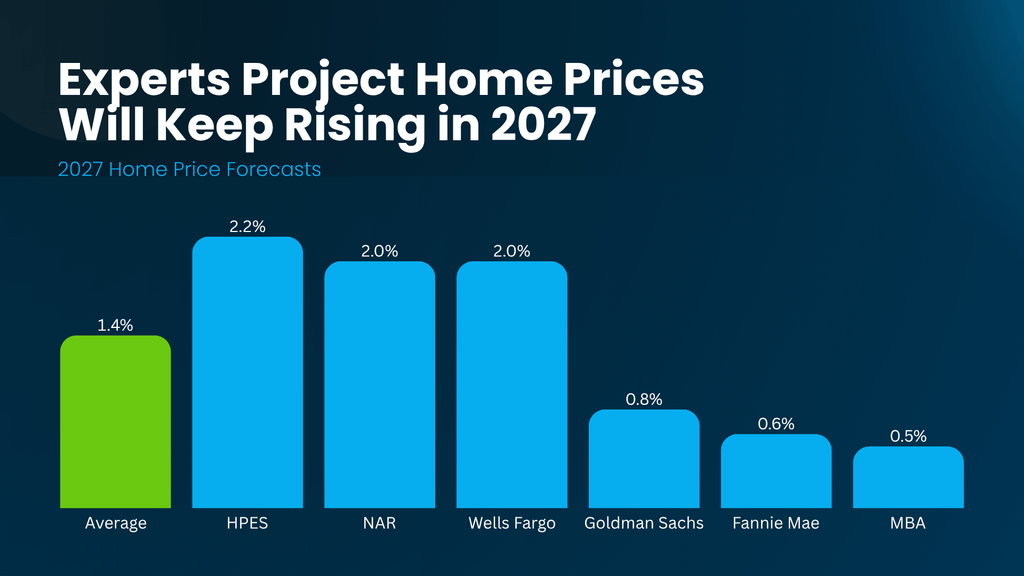
Real estate infographic titled “Experts Project Home Prices Will Keep Rising in 2027” highlighting national housing market forecasts from six leading real estate and financial organizations. The bar chart shows an average projected home price increase of 1.4% in 2027, with individual forecasts ranging from 0.5% to 2.2%. The Home Price Expectations Survey (HPES) projects 2.2% appreciation, followed by the National Association of REALTORS® (NAR) and Wells Fargo at 2.0%, Goldman Sachs at 0.8%, Fannie Mae at 0.6%, and the Mortgage Bankers Association (MBA) at 0.5%. All six forecasts anticipate continued home price appreciation, although at a relatively modest pace. These 2027 housing market predictions provide helpful context for homebuyers, sellers, homeowners, and real estate investors considering their next move in Allen, Plano, Fairview, McKinney, Frisco, Dallas, and surrounding North Texas communities. Working with an experienced local REALTOR® can help buyers and sellers understand how national housing trends compare with local market conditions and develop an informed real estate strategy. Actual home price appreciation will vary by location, housing inventory, buyer demand, mortgage rates, and economic conditions. Sources: HPES, NAR, Wells Fargo, Goldman Sachs, Fannie Mae, and MBA.

Prices are dipping in some markets, though. It just depends on where you live. Lawrence Yun, Chief Economist at the National Association of Realtors (NAR), explains why:

“Price declines are occurring mainly in southern states, where there has been robust new home construction in recent years. Given the region’s faster job growth, these price drops should be viewed as temporary and as a second-chance opportunity for those previously priced out of the market.”

So, the dips that are fueling all the social media chatter are limited to select areas, and experts think they’ll be short-lived. It doesn’t mean a crash is looming. 

If you’re thinking about moving, look at the numbers for your area.

“Is This 2008 All Over Again?”

Then your cousin chimes in about foreclosures. They’ve ticked up lately, but here’s some important context. That’s compared to very low levels. They’re still below where they were before the pandemic, according to ATTOM.

So, why doesn’t today look like 2008? Logan Mohtashami, Lead Analyst at HousingWire, explains:

“. . . we have had many recessions post-WWII but only one foreclosure crisis. That foreclosure crisis started with a massive credit boom from 2002-2005, and then a credit bust. . . none of that is happening now . . .“

Today’s homeowners also have something a lot of people didn’t have back then – equity. In every state, the average homeowner with a mortgage has more than $100,000 of it, according to Cotality (see map below):
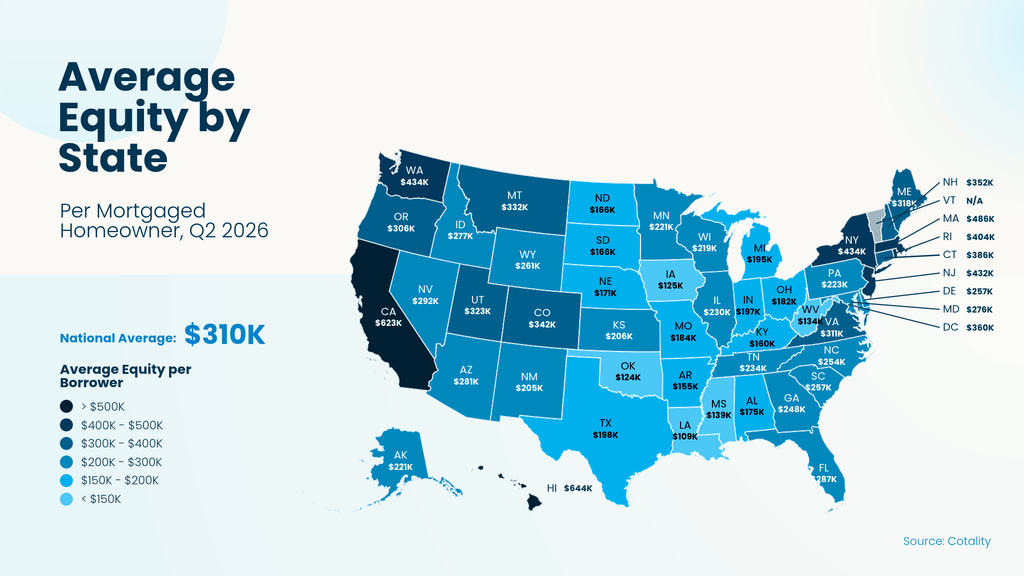
Real estate infographic titled “Average Equity by State” featuring a color-coded map of the United States showing average home equity per mortgaged homeowner during the second quarter of 2026. According to Cotality, the national average home equity is $310,000, while Texas homeowners with mortgages have an average of $198,000 in equity. Hawaii leads the nation with $644,000 in average home equity, followed by California at $623,000, Massachusetts at $486,000, and Washington and New York at $434,000 each. Louisiana has the lowest reported average at $109,000. The map illustrates significant regional differences in accumulated home equity and the financial benefits of long-term homeownership. These home equity statistics provide helpful context for homeowners, homebuyers, sellers, and real estate investors in Allen, Plano, Fairview, McKinney, Frisco, Dallas, and surrounding North Texas communities. Homeowners considering selling, purchasing another property, or accessing their accumulated equity can benefit from understanding local housing market conditions and working with an experienced REALTOR®. Individual home equity depends on property appreciation, outstanding mortgage balances, purchase price, and local real estate market conditions. Source: Cotality, Q2 2026.

If a homeowner hits a rough patch, they can usually sell their house instead of facing foreclosure.

“Are We Headed for a Recession?”

While someone in your family may be convinced a recession is coming, experts don’t agree. The average forecast from The Wall Street Journal’s survey of economists puts the odds at about 24%, so most experts aren’t expecting one. And that’s a good thing.

But even if one hits, history shows a recession doesn’t mean home prices will automatically fall. In 5 of the last 6 recessions, prices actually went up, according to the Federal Housing Finance Agency (FHFA) (see graph below):
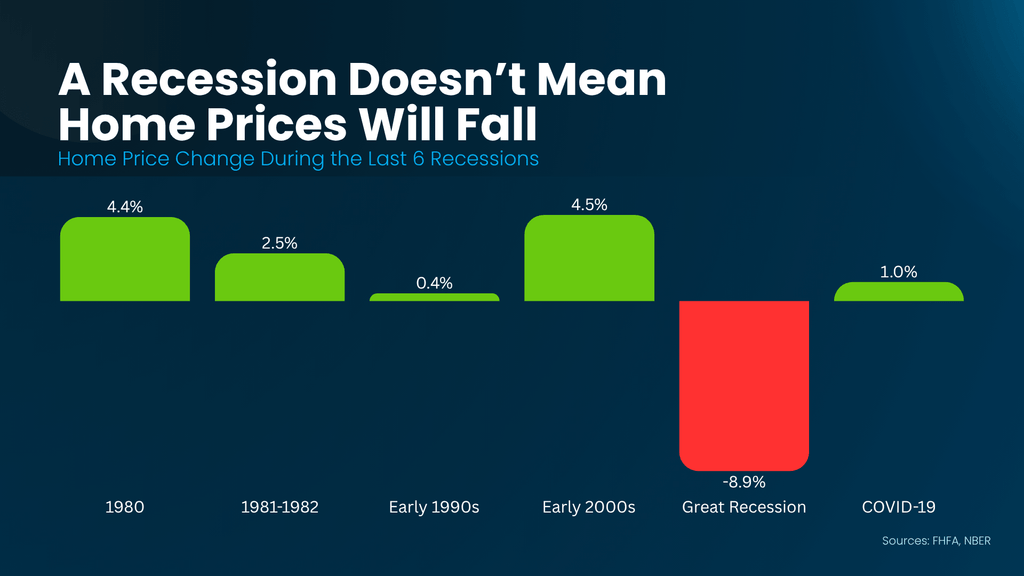
Real estate infographic titled “A Recession Doesn’t Mean Home Prices Will Fall” illustrating historical U.S. home price changes during the last six economic recessions. The bar chart shows that home prices increased during five of the six recessions, with appreciation of 4.4% in 1980, 2.5% in 1981–1982, 0.4% in the early 1990s, 4.5% in the early 2000s, and 1.0% during the COVID-19 recession. The Great Recession was the only period shown with declining home prices, recording an 8.9% decrease. This historical housing market data demonstrates that an economic recession does not automatically result in falling home prices or a housing market crash. Factors such as housing inventory, buyer demand, mortgage rates, lending standards, and local economic conditions influence real estate prices. These historical housing market trends provide helpful context for homebuyers, sellers, homeowners, and real estate investors in Allen, Plano, Fairview, McKinney, Frisco, Dallas, and surrounding North Texas communities. Working with an experienced local REALTOR® can help buyers and sellers distinguish national economic headlines from actual local housing market conditions and make informed real estate decisions. Historical performance does not guarantee future home price appreciation. Sources: Federal Housing Finance Agency (FHFA) and National Bureau of Economic Research (NBER).

The one exception was 2008, the only one of these recessions that started in the housing market itself.

Bottom Line

So, the next time your uncle predicts a crash or your cousin brings up 2008, you’ll know prices aren’t crashing, foreclosures are still low, and a recession doesn’t automatically spell trouble for housing. 

If a move in 2027 is on your mind, let’s look at what prices are doing in your neighborhood so you can plan with real local numbers, not scary headlines.


Join The Discussion